
Introduction
Traffic congestion, rising maintenance costs, damaged cables, and unreliable traffic signal infrastructure are major challenges for urban transportation in Pakistan. Modern intelligent transportation technology offers new ways to address these problems.
Wireless Traffic Signals Rawalpindi is an innovative traffic management project implemented by Pak German Engineers at GPO Chowk, Rawalpindi. The system combines AI-powered cameras, solar power, wireless communication, and adaptive traffic signal timing to help manage traffic flow efficiently and reduce dependence on conventional wiring.
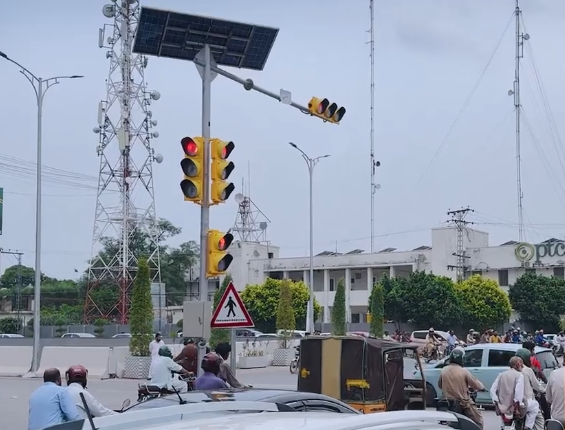
Pak German Engineers has implemented an AI-based wireless intelligent traffic signal system at GPO Chowk in Rawalpindi. According to the project interview, the system uses solar power, AI-enabled traffic monitoring cameras, and wireless communication between traffic controllers to adjust signal timings according to traffic demand.
This project demonstrates how intelligent traffic management technology can support more efficient intersections while reducing dependence on conventional underground wiring.
What Is an AI-Based Wireless Traffic Signal System?
An AI-based wireless traffic signal system uses traffic-monitoring technology and intelligent controllers to manage traffic signals according to changing road conditions.
Unlike a conventional system that relies on fixed signal timings, an adaptive traffic signal system can use real-time traffic information to adjust green-light durations.
The system installed at Rawalpindi’s GPO Chowk combines several technologies:
- AI-enabled traffic monitoring cameras
- Intelligent traffic signal controllers
- Wireless communication between controllers
- Solar power generation
- Battery backup
- Adaptive green-light timing
- Pedestrian crossing signals
These components work together to support traffic monitoring and signal coordination at the intersection.
How Does the Intelligent Traffic Signal System Work?
Explore the PIARC Road Network Operations guide for information about traffic management and intelligent transportation systems.
1. Real-Time Traffic Monitoring
AI-enabled cameras monitor traffic conditions at the intersection. The system evaluates the traffic load approaching from different directions to help determine which approach requires more green-light time.
2. Adaptive Green-Light Timing
When one direction has more traffic than another, the intelligent controller can allocate more green time to the busier approach, subject to its configured operating rules.
The interview describes a minimum green-light period of approximately 10–15 seconds, with additional timing adjusted according to traffic demand.
This approach can help use available intersection time more efficiently than relying exclusively on fixed timings.
3. Wireless Communication Between Controllers
According to the project interview, an individual traffic controller is installed at each signal pole. The controllers communicate through a private wireless network.
The described configuration includes one master controller and three slave controllers. This arrangement allows the connected signal equipment to coordinate its operations without requiring conventional inter-pole signal cabling.
4. Solar-Powered Operation
The system uses solar panels to provide power. This design can reduce dependence on conventional electrical connections and extensive underground power or communication wiring, depending on the installation configuration.
Battery backup is also part of the system’s design, helping support operation when solar generation is insufficient.
5. Pedestrian Safety Signals
The project also includes pedestrian crossing signals intended to support safer and more organized movement across the intersection.
Pedestrian signals are an important component of an integrated traffic management strategy, alongside vehicle signal control and traffic monitoring.
Key Features of the Rawalpindi GPO Chowk Project
AI-Based Traffic Monitoring
Traffic cameras help monitor the traffic load and provide information for adaptive signal timing.
Wireless Intelligent Control
Wireless communication between the controllers reduces dependence on conventional interconnecting cables.
Solar-Powered Infrastructure
Solar panels provide power to the system, offering an alternative to installations that depend entirely on conventional electrical connections.
Adaptive Signal Timing
Green-light duration can be adjusted according to traffic conditions, within the configured operating parameters.
Reduced Wiring and Road Cutting
The wireless configuration can reduce the need for underground cabling and associated road-cutting work, potentially lowering installation disruption and cable-related maintenance.
Battery Backup
The project interview describes backup operation intended to keep the system running for a configured period when normal power generation is unavailable. Actual backup duration depends on the system’s battery capacity and operating conditions.
Pedestrian Crossing Support
Dedicated pedestrian signals are included to help organize crossing movements and improve road-user awareness.
Why Wireless Traffic Signals Matter for Pakistan
Traditional traffic signal infrastructure can face maintenance challenges when underground cables are damaged, stolen, or disconnected. Road construction, flooding, and electrical supply problems can also affect conventional installations.
Wireless intelligent traffic signals offer a potential alternative by reducing dependence on interconnecting cables.
For cities such as Rawalpindi, Lahore, Karachi, Islamabad, Faisalabad, and Multan, suitable intelligent traffic management systems could support modernization of busy intersections.
However, the suitability of each installation depends on traffic patterns, site conditions, network reliability, power requirements, and the local authority’s technical specifications.
Benefits for Traffic Authorities and Road Users
Lower Cable-Related Maintenance
Reducing interconnecting wiring can help limit problems associated with damaged or stolen cables.
More Flexible Traffic Management
Adaptive signal timing can respond to changing traffic demand rather than relying solely on predetermined timings.
Reduced Installation Disruption
Wireless configurations may reduce the need for extensive road cutting and underground cable installation.
Alternative Power Arrangements
Solar power can reduce reliance on conventional electricity connections where the system is appropriately designed.
Better Traffic Visibility
Traffic-monitoring cameras can provide information about intersection conditions and traffic demand.
Potential for Long-Term Cost Efficiency
Reduced cabling and maintenance requirements may improve lifecycle costs. Actual savings depend on installation costs, battery replacement, equipment maintenance, and system performance.
Can the System Give Priority to Ambulances?
Emergency vehicle priority is an important feature in modern intelligent transportation systems. However, during the project interview, the representative clarified that ambulance detection and priority operation had not yet been implemented in the described installation.
The controller was described as having the potential to support such a feature, but an appropriate detection mechanism would also need to be installed in emergency vehicles and integrated with the traffic control system.
This distinction is important: future capabilities should not be presented as features already operational at the Rawalpindi site.
Developed and Implemented by Pak German Engineers
During the interview, the project representative identified Pak German Engineers as the company responsible for the traffic signal installation.
The representative also explained that the solution included in-house development alongside components sourced from suppliers in Europe and China.
According to the interview, installation was completed within approximately seven to eight days. This refers to the implementation period described by the representative, not the total research and development time.
The project is an example of how engineering development, suitable imported components, wireless communications, and solar power can be combined into an intelligent traffic control solution.
Traffic Light Controllers and Intelligent Transportation Solutions
Pak German Engineers offers a range of traffic light controller products for different traffic engineering applications.
The listed range includes microprocessor-based controllers, wireless intelligent traffic signal controllers, solar-powered controllers, auxiliary controllers, and coordinated traffic controller systems.
Selecting the appropriate equipment requires consideration of intersection geometry, traffic volume, signal groups, communications, power requirements, and compatibility with existing infrastructure.
Explore the company’s Traffic Light Controller Products to review the available product range.
For broader information about the company’s traffic engineering and intelligent transportation solutions, visit the official Pak German Engineers website.
The Future of Intelligent Traffic Management in Pakistan
As Pakistani cities continue to grow, traffic authorities need practical ways to manage congestion, improve road safety, and maintain reliable traffic signal infrastructure.
AI-assisted monitoring, adaptive signal timing, wireless controllers, and solar power can contribute to these goals when supported by appropriate engineering, reliable equipment, and effective maintenance planning.
The Rawalpindi GPO Chowk project provides an example of a wireless, solar-powered intelligent traffic signal installation by Pak German Engineers.
Future developments may include enhanced coordination between intersections, additional monitoring capabilities, and emergency vehicle priority where the required detection and communication systems are implemented.
Frequently Asked Questions
What is an AI-based wireless traffic signal system?
It is a traffic signal system that uses traffic monitoring, intelligent controllers, and wireless communication to adjust signal operations according to traffic conditions.
Where has Pak German Engineers installed this system?
The project described in the interview is located at GPO Chowk in Rawalpindi, Pakistan.
Does the Rawalpindi system use solar power?
Yes. According to the project interview, the system is solar-powered and includes battery backup.
How does the system adjust green-light timing?
AI-enabled cameras monitor traffic conditions, and the controllers use traffic-load information to allocate green-light time according to configured operating rules.
Does the system require conventional wiring between poles?
The described configuration uses a private wireless network to connect the individual traffic controllers, reducing the need for conventional inter-pole wiring.
Does it automatically give priority to ambulances?
Not in the installation described in the interview. Ambulance priority was discussed as a potential future feature requiring additional detection and integration.
How can I find traffic signal controllers from Pak German Engineers?
Visit the PGE Traffic Light Controller category to explore the listed products.
Conclusion
The AI-based wireless traffic signal system at Rawalpindi’s GPO Chowk illustrates an alternative approach to conventional traffic signal infrastructure. By combining AI-enabled monitoring, adaptive timing, wireless controller communication, and solar power, the installation aims to support responsive traffic management and reduce dependence on conventional cabling.
Pak German Engineers is contributing to this type of traffic engineering through its intelligent traffic signal projects and traffic controller product range.
For traffic signal controllers, intelligent transportation solutions, or project-specific technical discussions, visit Pak German Engineers.
Contact: info@pgepakistan.com
Phone: +92-321-5370486
Phone: +92-300-1118999