
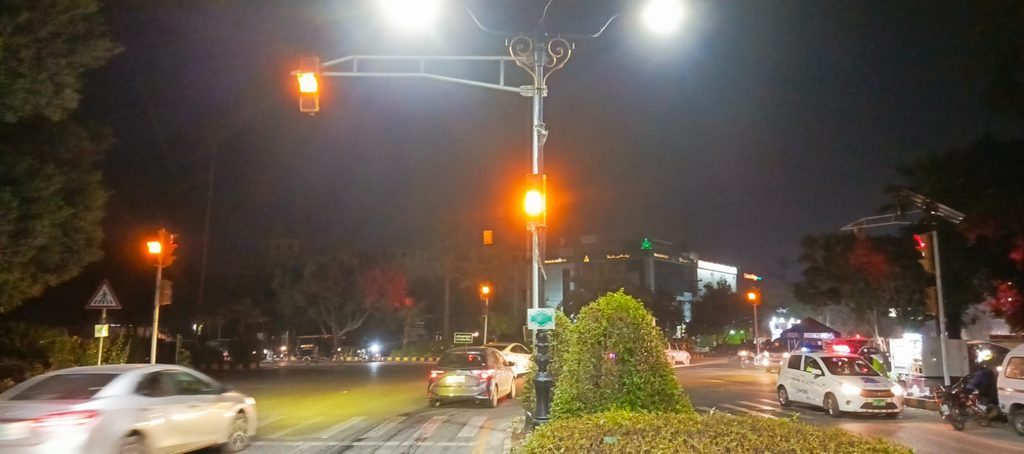
A flashing yellow traffic signal is used to tell road users to proceed with caution. Unlike a steady red signal, a flashing yellow signal generally does not require a complete stop under the U.S. MUTCD rules. Drivers should slow down, remain alert, check the intersection, and proceed only when it is safe to do so.
Flashing yellow signals can be used at intersections and other locations where drivers need additional awareness while traffic continues to move.
Important: Traffic signal rules can vary by country and jurisdiction. Always follow the traffic laws and signs applicable where you are driving.
What Should You Do When You See a Flashing Yellow Traffic Signal?
When approaching an intersection with a flashing yellow signal, drivers should take extra care and assess the road conditions before proceeding.
1. Slow Down
Reduce your speed as you approach the intersection. A flashing yellow signal is a warning to proceed cautiously, so drivers should be prepared for other vehicles, pedestrians, cyclists, or changing traffic conditions.
2. Look for Other Traffic
Check the intersection carefully before entering. Look for vehicles approaching from other directions and make sure your intended movement is safe.
3. Watch for Pedestrians
Pedestrians may be using the associated crosswalk. Under the U.S. MUTCD, vehicles facing a flashing yellow signal must yield to pedestrians lawfully within the associated crosswalk.
4. Follow Signs and Lane Markings
A flashing yellow signal does not override other traffic-control devices. Drivers should also follow regulatory signs, turn restrictions, lane markings, and other signals at the intersection.
5. Proceed Only When Safe
After checking the intersection and surrounding traffic, proceed cautiously when conditions allow. Do not treat a flashing yellow signal as an indication to speed through the intersection.
Flashing Yellow vs. Solid Yellow Traffic Signal
Although both signals use yellow, they communicate different conditions.
Flashing Yellow Signal
A flashing yellow signal generally warns drivers to proceed with caution. Under the U.S. MUTCD, vehicles may cautiously enter the intersection while yielding to pedestrians and vehicles that have the right-of-way.
Solid Yellow Signal
A steady yellow signal normally indicates that the green interval has ended and the signal is changing. Drivers should stop when they can do so safely; if stopping safely is not possible, they should proceed through the intersection cautiously according to applicable traffic rules.
What Is a Flashing Yellow Arrow?
A flashing yellow arrow is used for specific turning movements.
Under the U.S. MUTCD, a flashing yellow arrow allows the indicated movement to proceed cautiously while yielding to pedestrians and conflicting vehicles.
For example, a flashing yellow left-turn arrow can indicate that a driver may make the indicated turn after yielding to oncoming traffic and pedestrians when required.
Why Are Flashing Yellow Traffic Signals Used?
Flashing signal operation can be used as part of traffic control strategies at appropriate locations and during certain periods. The U.S. MUTCD allows traffic control signals to operate in flashing mode based on engineering study or engineering judgment.
Depending on the intersection design and traffic-control plan, flashing operation can help communicate a caution condition while maintaining traffic movement.
Modern traffic signal systems can also integrate signal controllers, detection technology, monitoring systems, and other intelligent transportation technologies.
Flashing Yellow Traffic Signals and Road Safety
Safe intersection management depends on more than the signal itself. Effective traffic control can involve:
- Proper signal timing
- Clear signal visibility
- Vehicle detection
- Pedestrian crossing systems
- Traffic signal controllers
- Road signs and markings
- Intersection monitoring
- Intelligent traffic management systems
Modern LED traffic signals can provide highly visible signal indications and can be integrated into broader traffic management infrastructure.
Smart Traffic Signal Systems
Modern cities are increasingly using intelligent traffic technologies to improve intersection management and traffic flow.
A smart traffic signal system may integrate:
- Traffic signal controllers
- Vehicle detection systems
- Smart cameras
- Radar detection
- Real-time traffic monitoring
- Adaptive signal control
- Pedestrian detection
- Centralized traffic management
These technologies can help transportation authorities monitor traffic conditions and manage intersections more effectively.
Frequently Asked Questions
What should you do when you see a flashing yellow traffic signal?
Slow down, check the intersection carefully, yield where required, and proceed cautiously when it is safe to do so. Always follow local traffic laws and other traffic-control devices.
Do you have to stop at a flashing yellow light?
Not necessarily. Under U.S. MUTCD rules, a flashing yellow signal permits vehicles to proceed cautiously rather than requiring a complete stop. Local laws may differ.
What is the difference between flashing yellow and flashing red?
A flashing yellow generally permits cautious movement, while a flashing red signal requires a stop before proceeding according to applicable stop rules.
Can pedestrians cross at a flashing yellow signal?
Pedestrian rules vary by jurisdiction. Under the U.S. MUTCD, pedestrians facing a flashing yellow indication may proceed across the associated roadway unless another pedestrian signal or traffic-control device directs otherwise, while yielding rules still apply.
Where are flashing yellow traffic signals used?
They can be used at selected intersections and locations where traffic engineers determine that flashing operation is appropriate. The exact use depends on local traffic engineering practices and regulations.
PGE Traffic Signal Solutions
Pak German Engineers (PGE) provides traffic engineering and intelligent transportation solutions for modern road infrastructure. Our areas of expertise include LED traffic lights, smart traffic signals, traffic signal controllers, pedestrian traffic systems, intelligent transportation systems, and traffic management solutions.
With experience in traffic engineering and smart infrastructure, PGE supports transportation projects focused on safer, more organized, and efficient road environments.
Explore PGE’s traffic signal solutions and intelligent transportation systems to learn more about modern traffic management technologies.
Conclusion
A flashing yellow traffic signal is an important traffic-control indication that requires drivers to slow down, stay alert, check surrounding traffic, and proceed cautiously when it is safe.
Understanding traffic signal meanings helps drivers make better decisions at intersections and contributes to safer road environments. Modern traffic signal technology can further support intersection management through LED signals, detection systems, intelligent controllers, and real-time traffic monitoring.