
Traffic signal lights are an essential part of modern road safety. They help control vehicle movements, reduce conflicts at intersections and provide clear instructions to drivers and pedestrians. But have you ever wondered who invented traffic signal lights and how these familiar red, yellow and green lights came into existence?
The history of traffic signals goes back to the nineteenth century, when growing cities needed better ways to manage horse-drawn carriages, pedestrians and increasingly busy roads.
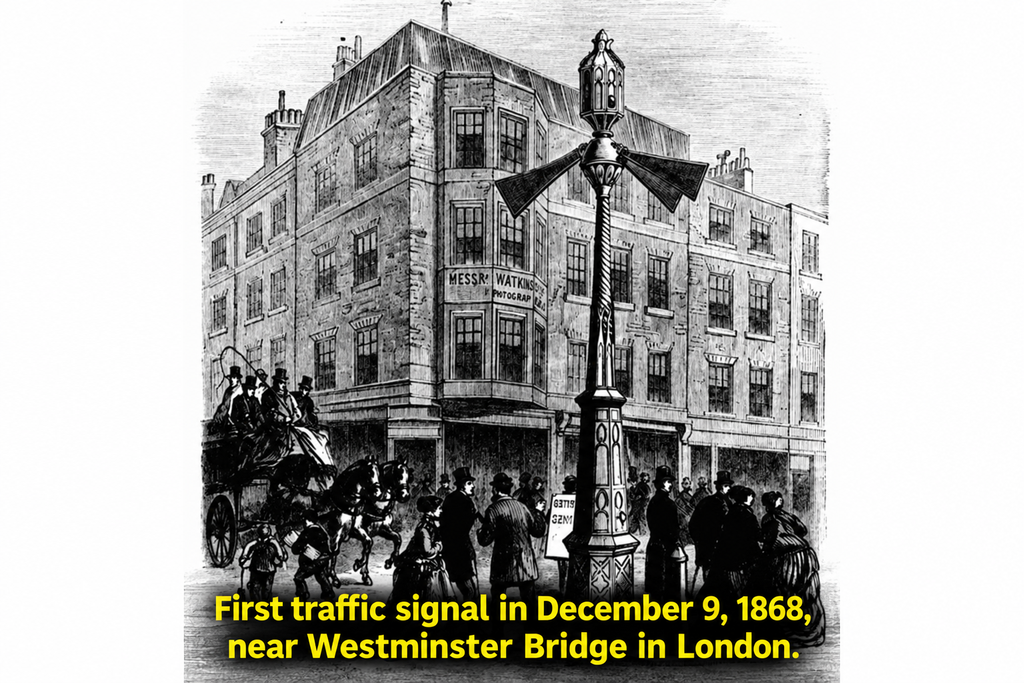
John Peake Knight is credited with designing the world’s first traffic signal, installed in London in 1868. However, modern electric traffic signals were developed later, with several inventors contributing to the technology used today. National Motor Museum
If you have ever wondered who invented traffic signal lights, the answer begins with British railway engineer John Peake Knight, who designed the first traffic signal installed in London in 1868.
Who Invented Traffic Signal Lights? The Original Invention
John Peake Knight was a British railway engineer who proposed a traffic signalling system based on railway signalling technology.
In December 1868, the world’s first traffic signal was installed near the Houses of Parliament in London, England. Its purpose was to help regulate traffic and make it safer for pedestrians crossing busy streets.
The early system was very different from the traffic lights we see today. It used mechanical semaphore arms during the day and red and green gas lamps at night. A police officer operated the signal manually.
Although this invention was an important step in traffic management, the system had a short life. In January 1869, a gas leak caused an explosion that injured the officer operating it, and the signal was subsequently removed. Live Science
When Was the First Electric Traffic Signal Installed?
The development of electric traffic signals marked another major milestone in road safety.
On August 5, 1914, an electric traffic signal system was installed at the intersection of East 105th Street and Euclid Avenue in Cleveland, Ohio, USA. The system was designed by James Hoge and used red and green lights to indicate when traffic should stop or move.
Understanding who invented traffic signal lights also requires looking at later developments, including the introduction of electric traffic signals in the United States in 1914.
Unlike the earlier gas-powered signal in London, this system used electric lights and could be controlled from an operating point. It is widely recognized as the first electric traffic signal installed in the United States. Cleveland Police Museum
This development helped establish the foundation for more practical traffic control systems in growing cities.
Who Invented the Three-Position Traffic Signal?
Garrett Augustus Morgan was an American inventor and entrepreneur who made an important contribution to traffic signal technology.
In 1923, Morgan received a United States patent for a three-position traffic signal. Earlier stop-and-go systems did not always provide a separate transition phase between conflicting traffic movements.
Morgan’s design introduced an additional caution or all-stop position, allowing an intersection to clear before traffic moving in another direction proceeded.
His invention was an important development in traffic safety. However, it is more accurate to credit John Peake Knight with the first traffic signal and Garrett Morgan with a significant advancement in three-position traffic signal design. Federal Highway Administration
How Did Traffic Signal Lights Evolve Over Time?
Traffic signals have progressed from manually operated mechanical devices to electronically controlled systems capable of responding to changing road conditions.
1. Mechanical and Gas-Powered Signals
The earliest traffic signals used semaphore arms and gas lamps. They required manual operation and were designed for the traffic conditions of the nineteenth century.
2. Electric Traffic Signals
Electric traffic signals became an important development in the early twentieth century. They made illuminated stop-and-go instructions more practical for managing road intersections.
3. Three-Colour Traffic Lights
The introduction of a separate caution phase helped improve the transition between conflicting traffic movements. Red, yellow and green signals subsequently became the familiar standard for road traffic control.
4. Automatic Traffic Signal Controllers
Automatic controllers made it possible to operate traffic signals according to programmed timing rather than relying entirely on manual control.
5. Intelligent Traffic Signal Systems
Modern intelligent transportation technologies can use vehicle detectors, sensors, communication networks and adaptive controllers to support traffic management.
Depending on the installation, these systems can monitor traffic volumes, adjust signal timing, coordinate intersections and provide information to traffic operators.
What Do Red, Yellow and Green Traffic Lights Mean?
The three familiar traffic signal colours communicate different instructions to road users.
- Red light: Stop before the designated stop line, in accordance with the applicable traffic rules.
- Yellow light: Prepare to stop when it is safe to do so, following the applicable local traffic rules.
- Green light: Proceed when the way is clear and it is safe to move, while yielding where required.
Understanding and following these signals helps drivers and pedestrians navigate intersections more safely.
Why Are Modern Traffic Signal Systems Important?
As cities grow and vehicle numbers increase, effective traffic management becomes increasingly important. Well-designed traffic signal systems help organize movements at intersections and support safer road use.
Modern traffic engineering solutions can offer several benefits:
Improved traffic flow: Appropriate signal timing can help manage queues and reduce unnecessary waiting at intersections.
Enhanced road safety: Clear signal indications help communicate right-of-way instructions to drivers and pedestrians.
Better pedestrian protection: Dedicated pedestrian signals and suitable crossing phases can help organize pedestrian movements.
More efficient traffic monitoring: Vehicle detection systems can provide information about traffic conditions and support informed signal control.
Improved operational management: Connected traffic systems can help operators monitor selected intersections and coordinate traffic management activities.
Actual results depend on traffic conditions, road design, system configuration and proper maintenance.
What Are Intelligent Transportation Systems (ITS)?
Intelligent Transportation Systems, commonly known as ITS, combine technology and transportation infrastructure to improve the management of roads and traffic.
Depending on project requirements, ITS solutions may include:
- Intelligent traffic signal controllers
- Vehicle detection and traffic monitoring systems
- LED traffic lights
- Pedestrian crossing systems
- Variable Message Signs (VMS)
- Traffic countdown timers
- Radar-based speed warning systems
- Solar-powered traffic safety equipment
These technologies can help authorities and infrastructure operators respond more effectively to traffic conditions when they are appropriately designed and integrated.
Traffic Signal Solutions in Pakistan
Pakistan’s growing urban centres need reliable traffic management infrastructure to support increasing road usage. Traffic signals, pedestrian crossings and intelligent traffic control systems can all contribute to better-organized road networks.
Choosing the right solution requires consideration of intersection geometry, traffic volume, pedestrian requirements, electrical infrastructure, equipment specifications and maintenance needs.
Pak German Engineers (PGE) provides traffic engineering and intelligent transportation solutions for infrastructure requirements. Project teams can explore suitable traffic signal equipment and related technologies according to their operational and technical needs.
To learn more about available solutions, visit PGE Pakistan.
Frequently Asked Questions (FAQs)
Who invented traffic signal lights and when?
John Peake Knight designed the first traffic signal, which was installed in London in December 1868. Electric traffic signals were developed later.
When was the first traffic light invented?
The first traffic signal was installed in London in 1868. The first widely recognized electric traffic signal in the United States was installed in Cleveland, Ohio, on August 5, 1914.
Did Garrett Morgan invent the first traffic light?
No. Garrett Morgan is known for his patented three-position traffic signal, for which he received a US patent in 1923. John Peake Knight’s traffic signal came earlier, in 1868.
Who invented the first electric traffic signal?
The electric traffic signal installed in Cleveland in 1914 was designed by James Hoge. Other inventors, including Lester Wire, also contributed to the development of early electric traffic signalling.
Why are traffic lights red, yellow and green?
These colours provide standardized stop, caution and go indications. Their widespread use helps road users understand traffic instructions consistently.
How do modern intelligent traffic signals work?
Depending on the system, modern traffic signals use electronic controllers, programmed timing and sometimes vehicle detectors or communication technologies to manage traffic movements.
Conclusion
The history of traffic signal lights began with John Peake Knight’s pioneering system in London in 1868. Later developments by James Hoge, Garrett Morgan and other inventors helped transform traffic signalling into the electric and electronically controlled systems used today.
From simple mechanical signals to intelligent transportation technologies, traffic signals continue to play an important role in managing road movements and supporting safer journeys.
Learning who invented traffic signal lights reveals how early traffic control systems evolved into the modern signal technologies used to manage roads and intersections today.
For organizations planning traffic signal installations, intersection upgrades or intelligent transportation projects in Pakistan, selecting suitable equipment and obtaining appropriate engineering support are important steps towards reliable traffic management.
Explore traffic engineering and intelligent transportation solutions with Pak German Engineers (PGE).